
Dicamba OTT Is Back for 2026 — With Significant ESA Changes
Stay Updated on ESA Restrictions
On February 6, 2026, the EPA issued a time-limited registration for over-the-top (OTT) dicamba on dicamba-tolerant cotton and soybeans — the first approval since the 2024 court vacatur. The registration covers the 2026 and 2027 growing seasons across 34 states and includes what the EPA calls the strongest protections in agency history for OTT dicamba use.
This registration introduces new compliance obligations that directly affect how you sell, recommend, and support dicamba applications. Below we break down what changed, what it means for the acres you serve, and how to stay ahead of it.
Registered Dicamba OTT Products
Three products have been registered for over-the-top use on dicamba-tolerant crops:
| EPA Reg. No. | Product Name | Manufacturer |
|---|---|---|
| 264-1241 | Stryax Herbicide | Bayer |
| 7969-507 | Engenia Herbicide | BASF |
| 100-1753 | Tavium Plus VaporGrip Technology | Syngenta |
Pesticide Use Limitation Areas: Refined and Reduced
The EPA's updated PULA boundaries reflect a refined core mapping process that significantly reduces the total acreage under use limitations compared to the previous registration. Across all states, PULA coverage dropped from approximately 129.6 million acres to 12.8 million acres — a 90.2% reduction.
90.2% Reduction in PULA Acreage 129.6M acres → 12.8M acres under Pesticide Use Limitation Areas
While this is a substantial reduction in overall restricted acreage, the PULAs that remain are more targeted and carry stricter requirements. Here's how the top 10 most affected states compare:
Top 10 States by 2026 PULA Acreage Dicamba PULAs exist in additional states beyond those listed below. Grand total reflects all states. Check Bulletins Live! Two for complete coverage.
| State | Previous PULAs (acres) | 2026 PULAs (acres) | % Change |
|---|---|---|---|
| Alabama | 5,257,601 | 2,499,630 | -52.5% |
| North Carolina | 17,058,832 | 1,217,346 | -92.9% |
| South Carolina | 7,376,841 | 984,308 | -86.7% |
| Minnesota | 4,902,368 | 977,891 | -80.1% |
| New Jersey | 109,366 | 950,238 | +768.9% |
| Missouri | 4,213,028 | 883,042 | -79.0% |
| Illinois | 8,202,984 | 848,801 | -89.7% |
| Tennessee | 4,383,440 | 696,296 | -84.1% |
| Nebraska | 1,736,182 | 627,830 | -63.8% |
| North Dakota | 8,066,697 | 488,851 | -93.9% |
| All States Total | 129,594,322 | 12,758,435 | -90.2% |
Key Use Limitations for the 2026 Label
Regardless of PULA status, every OTT dicamba application now carries these baseline requirements:
Application Rate Cut in Half
Max 2 applications at 0.5 lb/acre = 1.0 lb total annually (down from 2.0 lb under the 2020 label).
Doubled VRA Requirement
40 oz/acre of approved Volatility Reduction Agent on every application (up from 20 oz). These agents chemically bind dicamba molecules so they stay where they're sprayed instead of evaporating into the air.
Temperature Restrictions
This is the biggest change from the previous registration. The old calendar-based cutoff dates (e.g., mid-June) have been replaced with temperature-based rules:
- ≥95°F forecasted on the day of or day after application → no applications allowed
- 85–95°F forecasted → only 50% of untreated DT acres in a county may be treated, with a 2-day wait before treating the rest
Aerial Application Prohibited
Ground application only.
Runoff & Drift Mitigation
Runoff/Erosion Mitigation (All Fields)
Every treated field must achieve 3 runoff/erosion mitigation points from EPA's Mitigation Menu, unless the field meets the exemption criteria. Qualifying practices include:
- Vegetative buffer strips
- Cover crops
- Contour farming
- Grassed waterways
- Reduced tillage
These physically prevent dicamba from moving off-field in runoff or eroded soil.
Full list of qualifying practices: EPA Mitigation Menu
Enhanced PULA Requirements (6 Points)
Fields located within a Pesticide Use Limitation Area require 6 mitigation points — double the standard requirement.
Applicators must check Bulletins Live! Two before every application to determine whether their field falls within a PULA.
Drift Protections
The following drift mitigation requirements remain in effect or have been strengthened:
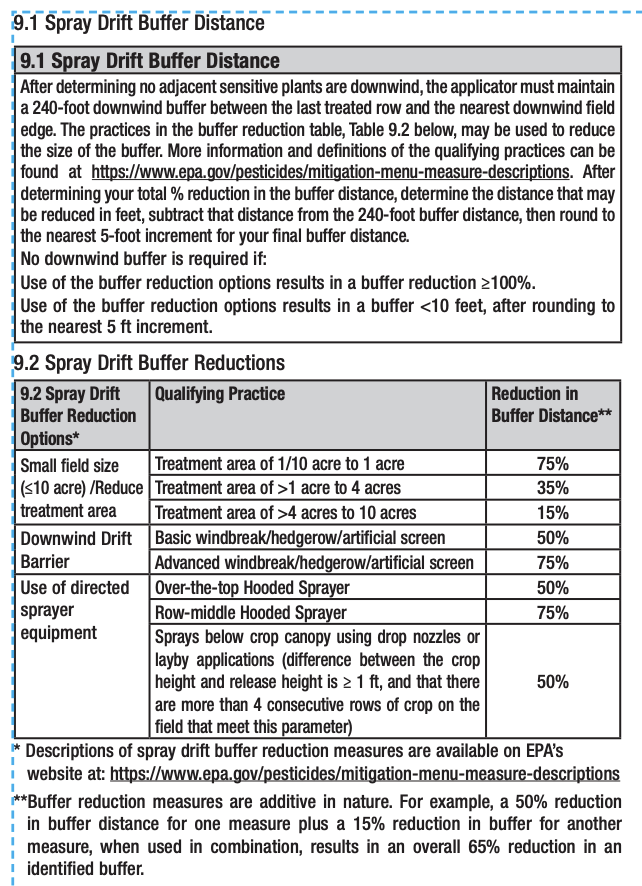
- 240-foot downwind spray drift buffer (may be reduced only using the buffer reduction options listed on the product label — not the full EPA Mitigation Menu)
- Mandatory Drift Reduction Agent in every tank mix
- Coarse or coarser spray droplets at no more than 2 feet above ground or crop canopy
- Wind speed between 3–10 mph
- No spraying during temperature inversions, within 48 hours of forecasted rain, when soil is saturated, or within one hour after sunrise/two hours before sunset
- No application if dicamba-sensitive crops or plants are in downwind areas
Legacy Restrictions Retained
The 2026 label carries forward several requirements from previous registrations:
- Annual mandatory training specific to OTT dicamba use
- Personal protective equipment for loaders, mixers, handlers, and applicators
- 24-hour Restricted Entry Interval — no re-entry to treated fields within 24 hours
- Tank mixing prohibition — no ammonium sulfate-containing products (increases volatility)
- Mandatory recordkeeping for every application
Know Your Fields Before You Spray
AcreBlitz makes it easy to determine whether your customers' fields fall within a dicamba PULA — and exactly what mitigation points are required. Our PULA Check API and ESA Field Exchange platform give trusted advisors instant, field-level ESA compliance answers so you can advise with confidence and keep applicators on the right side of the label.
Learn More at AcreBlitz.com →Source: EPA Registration of Dicamba for Use on Dicamba-Tolerant Crops, February 6, 2026. PULA acreage calculated from EPA Bulletins Live! Two geospatial data.