
How Many Products Actually Have ESA Limitations?
Stay Updated on ESA Restrictions
When discussing ESA compliance, one of the most common questions we hear from retailers and applicators is:
“How many products actually have ESA limitations?”
The assumption tends to fall into one of two extremes:
- Either only a tiny handful of products are affected,
- or nearly every product somehow triggers ESA requirements.
The reality is more nuanced — and more important — than either misconception.
Thanks to EPA data and our internal analysis, we can quantify the scope:
- 341 total products have Bulletins Live! Two (BLT) limitations
- 316 of those are active products
- 305 active products contain ESA label language
Note: These numbers reflect the data available at the time of publishing (October 2025) and will likely change as EPA continues to update labels, issue new Bulletins, and modify existing registrations. For the most current information, refer to the ESA-Impacted Products page.
This means only a fraction of EPA-registered products include ESA restrictions —
but for the products that do, the requirements are increasingly complex.
You can view the full, up-to-date list of affected products here:
👉 View ESA-Impacted Products
Understanding the Three Categories of ESA-Impacted Products
To interpret the numbers correctly, it helps to distinguish the three groups.
1. Products With Bulletin (BLT) Limitations (341 total)
These products have one or more active ESA Bulletins in Bulletins Live! Two (BLT).
If an application site intersects a PULA for the relevant date, the applicator must abide by the Bulletin, along with any additional label limitations.
Bulletin limitations are:
- Species-specific
- Geography-specific
- Date-dependent
2. Active Products With Bulletin Limitations (316 active)
This subset excludes canceled, archived, or inactive registrations.
For these 316 active products, the applicator must:
- Check BLT within 6 months of application
- Determine whether the site is within a PULA
- Follow Bulletin instructions if inside a PULA
3. Active Products With ESA Language (305 active)
This category is the most misunderstood.
Not all Bulletin-covered products contain the new EPA ESA language.
Label Language Examples
Pesticide labels include specific language directing applicators to check for Bulletins. The EPA has updated this language over time to clarify requirements and point users to Bulletins Live! Two and the EPA Mitigation Menu where appropriate.
Older Label Language

Older labels referenced the previous system and required checking Bulletins "no earlier than six months before using this product."
Updated Label Language
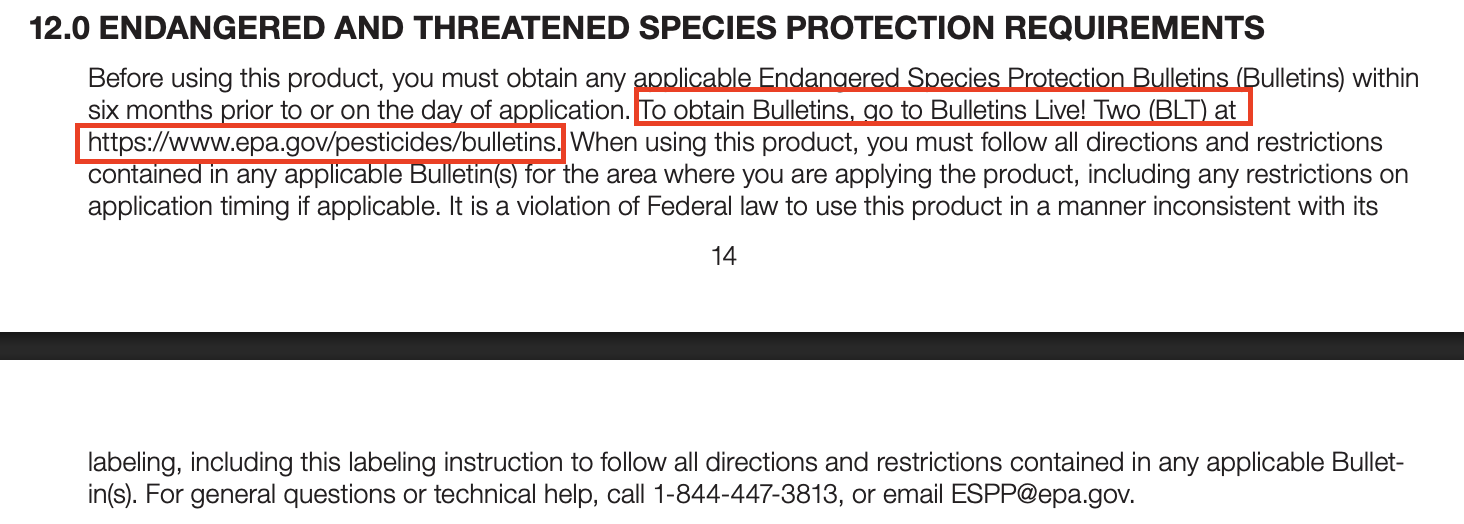
Newer labels direct users to Bulletins Live! Two (BLT) at https://www.epa.gov/pesticides/bulletins and emphasize that Bulletins must be obtained "within six months prior to or on the day of application."
Both versions are legally enforceable, but the updated language provides clearer guidance on accessing the current BLT system.
These are the products where BLT is an enforceable requirement today.
This group is rapidly growing as EPA updates labels under its national ESA mitigation strategies.
Why Most ESA Limitations Are NMFS-Driven
A key but often overlooked detail:
Most ESA-impacted pesticide products fall under NMFS (National Marine Fisheries Service)
Why?
- Many products present aquatic toxicity risks
- Surface water and drainage networks link inland agriculture to downstream protected habitats
- NMFS is responsible for many salmonid and aquatic invertebrate species impacted by agricultural runoff and drift
Putting the Numbers in Context
Let’s interpret the breakdown:
341 products
have Bulletin limitations.
316 active products
require real-time geographic verification.
305 active products
contain ESA label language —
including those with new Section 11 requirements
that may apply even outside PULAs.
(These require a BLT lookup within 6 months of application.)
And the overlap matters
A product may:
- Have ESA label language but no active Bulletin,
- Have active Bulletins but old ESA language, or
- Have both new ESA language and active Bulletins (the strictest case).
This explains why ESA compliance cannot be reduced to “check BLT only if you’re in a PULA.”
View All ESA-Impacted Products
For applicators, retailers, or compliance managers wanting the complete list:
This page displays:
- Products with ESA language
- Products with active Bulletin limitations
- Label language (old vs. new ESA language)
- Registration status
It is updated as labels change and as EPA modifies Bulletins.
Summary
ESA limitations apply to far fewer products than many assume —
but for the products that do contain restrictions, those requirements are more detailed and dynamic than ever.
- 341 products have Bulletin limitations
- 316 of these are currently active
- 305 active products contain ESA label language
- Most ESA impacts originate from NMFS
- New EPA label language includes mitigation points, county scoring, and off-PULA requirements
As labels continue transitioning to the new framework, understanding these categories — and the differences between them is essential for accurate, defensible ESA compliance.