Enlist and Runoff Mitigation: Why Compliance Is More Complicated Than You Think
Stay Updated on ESA Restrictions
Enlist and Runoff Mitigation: Why Compliance Is More Complicated Than You Think
If you use Enlist Duo or Enlist One, you're probably aware that the labels have runoff mitigation requirements. What you might not realize is that these requirements operate under a completely different system than the EPA Mitigation Menu that applies to other pesticides picking up ESA-related label language.
That difference matters. Practices that earn you points under the EPA Mitigation Menu may not count or may count for less under Enlist's label specific credit system. Fields that are fully compliant for other products might fall short for Enlist applications. And the way you determine how many credits you need is fundamentally different.
Let's walk through how we got here and what it means for your farm.
The History of Enlist Registrations
Understanding why Enlist's compliance system is different requires a quick look at the product's regulatory history.
Enlist Duo: 2014
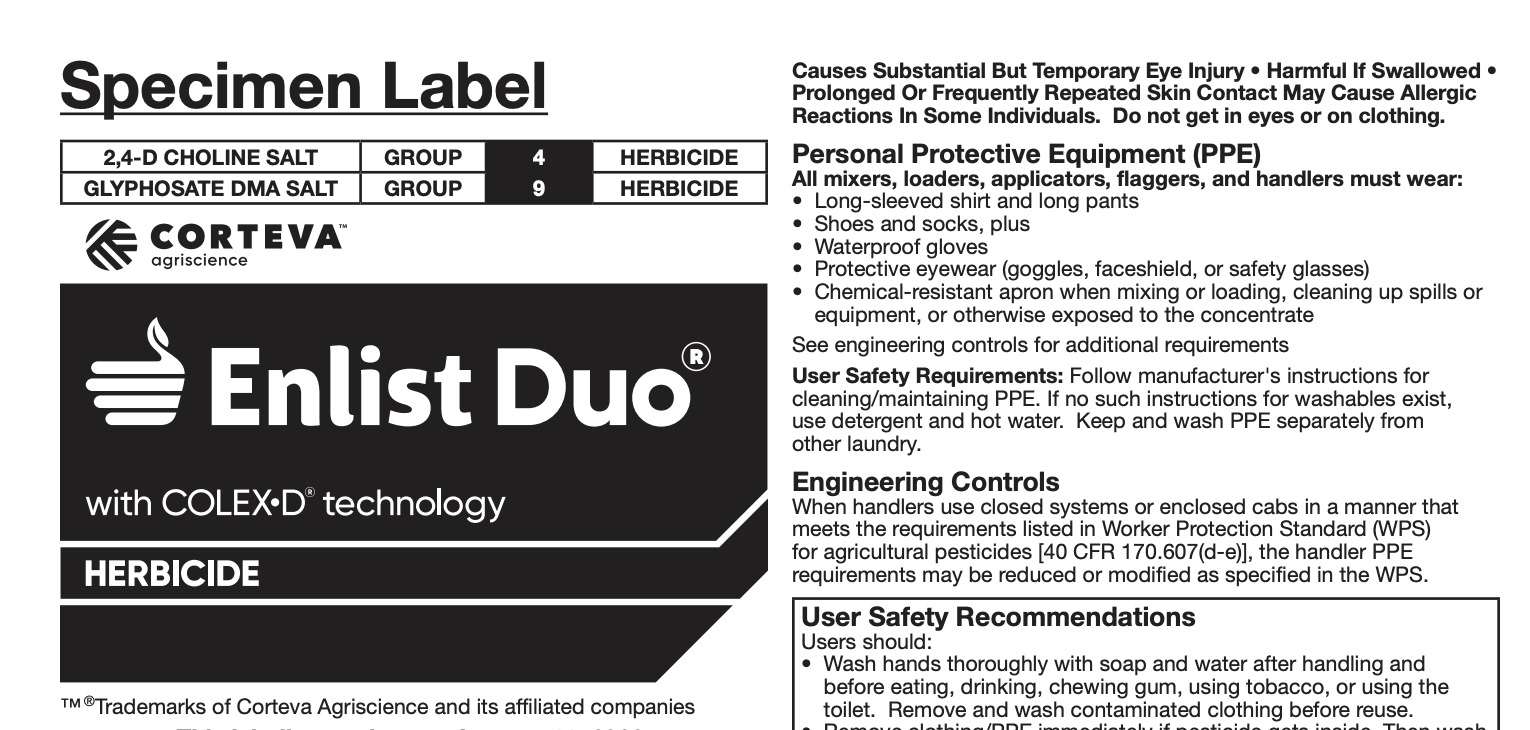
Enlist Duo was first registered in 2014. It contains two active ingredients: 2,4-D choline salt (a Group 4 herbicide) and glyphosate dimethylammonium salt (a Group 9 herbicide). The product was designed for use on Enlist corn, soybeans, and cotton—crops genetically modified to tolerate 2,4-D applications that would damage conventional varieties.
The 2,4-D choline formulation was specifically developed to reduce volatility and drift compared to older 2,4-D formulations. At registration, the label included spray drift restrictions but no runoff mitigation point system.
Enlist One: 2017
Enlist One followed in 2017 as a 2,4-D choline-only option (no glyphosate). This gave growers flexibility to tank-mix their own glyphosate or use Enlist One in situations where glyphosate wasn't needed. The label mirrored Enlist Duo's restrictions.
The 2022 Registration Renewal: Everything Changed
In January 2022, EPA renewed the time limited registrations for both Enlist products but with significant new restrictions driven by Endangered Species Act concerns.
The 2022 renewal added:
- County-level use prohibitions in areas where EPA determined Enlist use would likely affect on-field listed species that use corn, cotton, or soybean fields for habitat or diet
- A runoff mitigation credit system requiring growers to implement specific practices before application
- Bulletins Live! Two requirements mandating applicators check for location specific restrictions within six months of application
- A 48-hour rainfall/irrigation restriction prohibiting application when precipitation is expected or when soil is at field capacity
Two months later, in March 2022, EPA issued supplemental labeling that expanded use to 134 additional counties that were either not originally proposed or had been prohibited under the January decision.
Where We Are Now
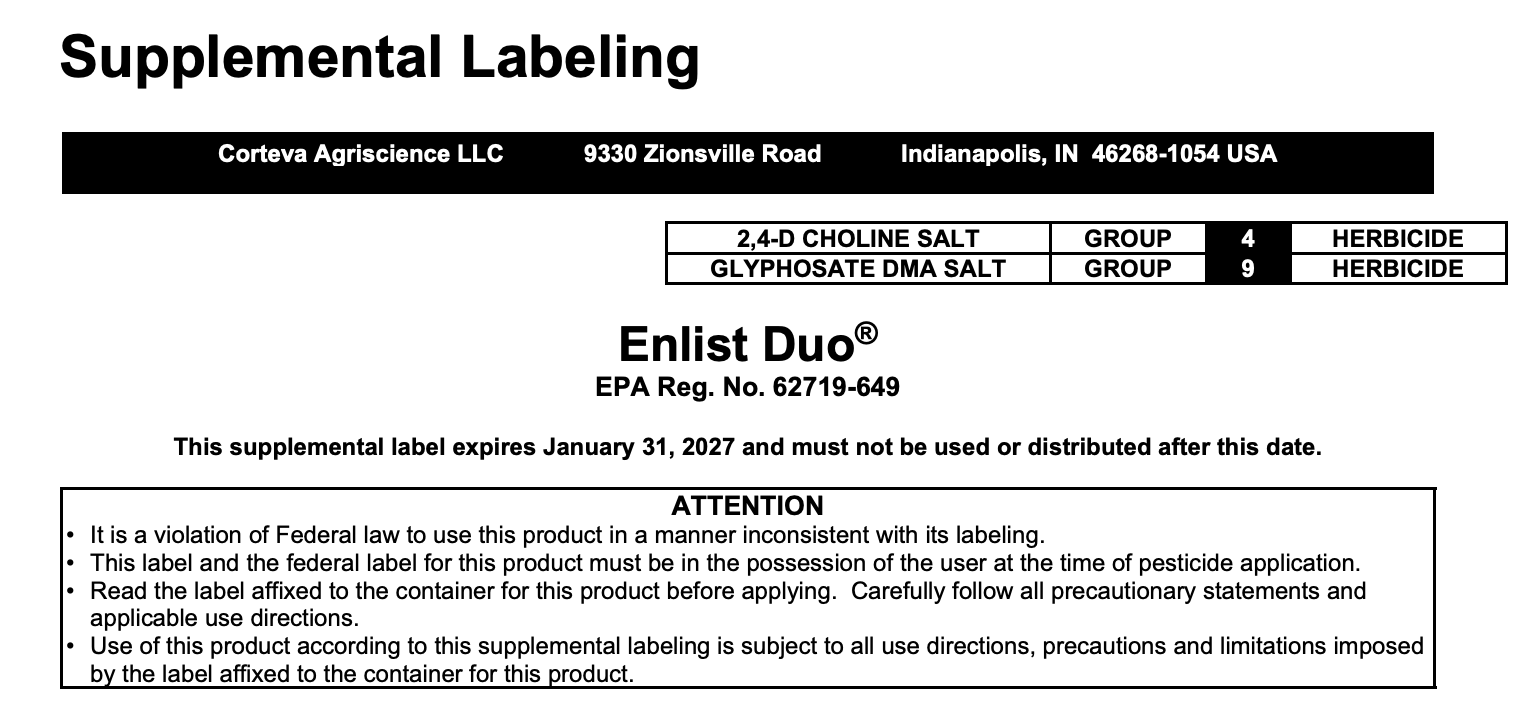
Both Enlist Duo and Enlist One operate under time limited registrations that expire January 31, 2027. The labels include the runoff mitigation credit system established in 2022, a system that was developed specifically for these products before EPA finalized its broader Mitigation Menu framework.
That timing is the root of the compliance problem.
How Enlist's Runoff Mitigation Credit System Works
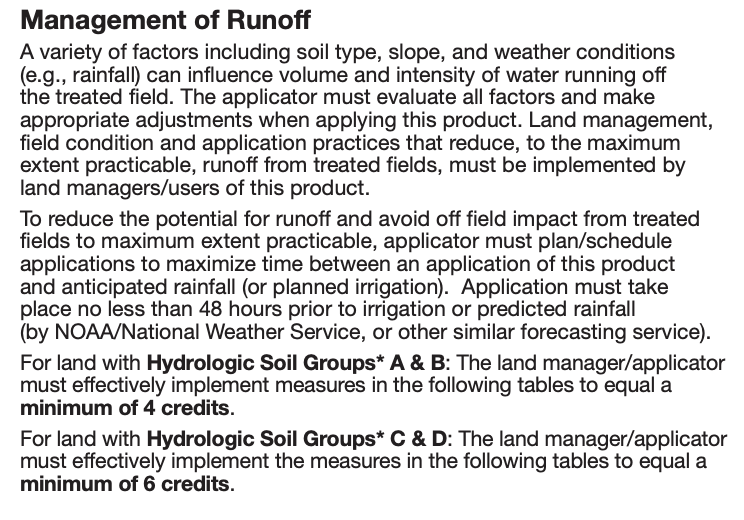
The Enlist label takes a different approach to runoff mitigation than products that reference the EPA Mitigation Menu.
Determining Your Credit Requirement
Under Enlist's system, the number of credits you need depends on the Hydrologic Soil Group (HSG) at your specific field:
| Hydrologic Soil Group | Soil Characteristics | Credits Required |
|---|---|---|
| HSG A | ≤10% clay, ≥90% sand (sand, loamy sand, sandy loam) | 4 credits |
| HSG B | 10-20% clay, 50-90% sand (sandy clay loam) | 4 credits |
| HSG C | Silt loam, loam | 6 credits |
| HSG D | Clay loam, silty clay loam, sandy clay, silty clay, clay | 6 credits |
This is a field level determination. If you have heavier soils (HSG C or D), you need 50% more credits than someone farming sandy ground.
There Is No Baseline Relief
Here's where Enlist diverges sharply from the EPA Mitigation Menu: you always start at zero.
Under the EPA Mitigation Menu, growers can claim points for factors outside their control: their county's runoff vulnerability rating, their field slope, their soil type. A grower in a low vulnerability county with flat, sandy fields might start with 6 or more points before implementing any practices.
Under Enlist's system, none of that applies. It doesn't matter if you're in the lowest runoff risk county in the country. It doesn't matter if your fields are laser leveled flat. You don't get credit for tracking your mitigations. Every credit must come from specific practices or application decisions.
How to Earn Credits
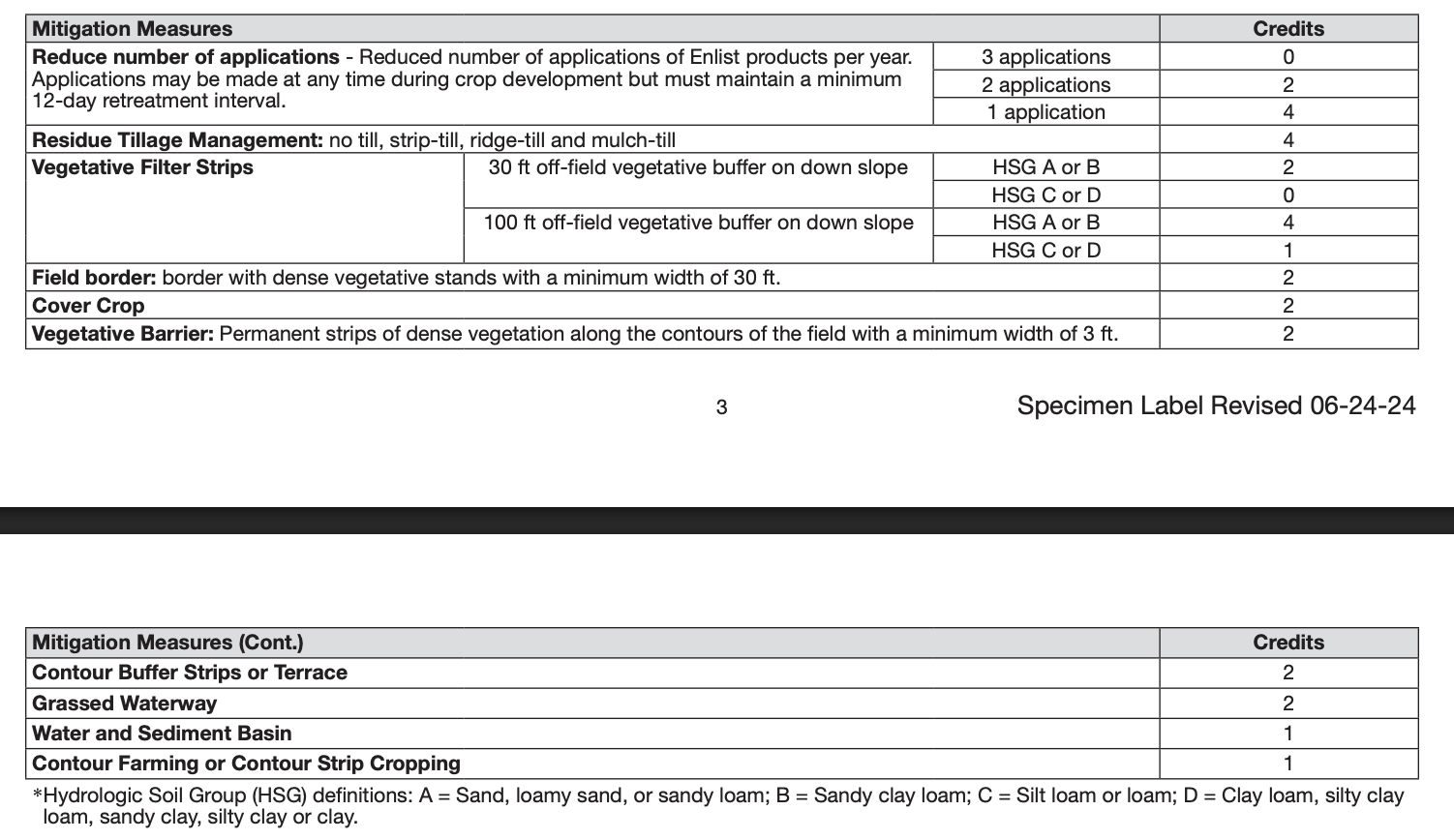
The Enlist label defines specific practices and their credit values:
Application Reduction Credits
| Practice | Credits |
|---|---|
| 3 Enlist applications per year | 0 |
| 2 Enlist applications per year | 2 |
| 1 Enlist application per year | 4 |
This is unique to Enlist—the EPA Mitigation Menu doesn't offer points for reducing application frequency for runoff mitigation.
Tillage and Soil Management
| Practice | Credits |
|---|---|
| Residue tillage management (no-till, strip-till, ridge-till, mulch-till) | 4 |
| Cover crop | 2 |
| Contour buffer strips or terrace | 2 |
| Contour farming or contour strip cropping | 1 |
Vegetative Practices
| Practice | HSG A/B | HSG C/D |
|---|---|---|
| 30-ft off-field vegetative buffer (downslope) | 2 | 0 |
| 100-ft off-field vegetative buffer (downslope) | 4 | 1 |
| Field border (30 ft min, dense vegetation) | 2 | 2 |
| Vegetative barrier (3 ft min, along contours) | 2 | 2 |
| Grassed waterway | 2 | 2 |
Water Management
| Practice | Credits |
|---|---|
| Water and sediment basin | 1 |
Notice the soil type dependency on vegetative buffers. A 30-foot buffer that's worth 2 credits on sandy soils is worth zero on HSG C/D soils. That same buffer would earn 1 point under the EPA Mitigation Menu regardless of soil type.
Additional Hard Requirements
Beyond the credit system, the Enlist label includes non-negotiable requirements:
- 48-hour rainfall restriction: No application when rainfall is predicted by NOAA/National Weather Service within 48 hours
- 48-hour irrigation restriction: No irrigation that would result in runoff within 48 hours after application
- Soil field capacity: No application when soil can no longer absorb water
- Practice specifications: All mitigation practices must meet minimum criteria defined at Enlist.com/mitigationmeasures
How the EPA Mitigation Menu Works Differently
To understand why Enlist compliance is harder, you need to see how the EPA Mitigation Menu approaches the same problem.
Threshold Determination
Under the EPA Mitigation Menu, the number of points you need is set on the product label or in Bulletins Live! Two—typically a flat number like 3, 4, or 6 points that applies across all geographies where the product is registered. Some products have higher requirements in specific Pesticide Use Limitation Areas identified in Bulletins.
Baseline Relief Is Built In
The EPA Mitigation Menu gives growers credit for factors that reduce runoff risk at their location:
| Relief Category | Points Available |
|---|---|
| Very low runoff vulnerability county | 6 |
| Low runoff vulnerability county | 3 |
| Medium runoff vulnerability county | 2 |
| High runoff vulnerability county | 0 |
| Field slope ≤3% | 2 |
| Sandy soils (HSG A) | 3 |
| Sandy soils (HSG B) | 2 |
| Documented mitigation tracking | 1 |
| Technical specialist or conservation program | 1-2 |
| EPA-Qualified Conservation Program (e.g., EQIP with CPS 595) | 9 |
A grower in a low-vulnerability county with flat fields, sandy soils, and documented tracking could start with 9 points—enough to satisfy most label requirements without adding any new practices.
Practice Values Differ
Even where both systems credit the same practices, the values often differ:
| Practice | EPA Mitigation Menu | Enlist Label |
|---|---|---|
| No-till | 3 points | 4 credits |
| Reduced tillage | 2 points | 4 credits (same as no-till) |
| Cover crop (no-till, long-term) | 3 points | 2 credits (flat rate) |
| Cover crop (with tillage) | 1 point | 2 credits (flat rate) |
| 30-ft vegetative buffer | 1 point | 2 credits (HSG A/B) or 0 (HSG C/D) |
| 60+ ft vegetative buffer | 3 points | Not defined at this width |
| 100-ft vegetative buffer | Not defined | 4 credits (HSG A/B) or 1 (HSG C/D) |
| Grassed waterway | 2 points | 2 credits |
The EPA Mitigation Menu also offers credits for practices Enlist doesn't recognize, including irrigation water management, mulching, erosion barriers, anionic polyacrylamide application, and precision application technology.
Where the Systems Collide
The lack of alignment between these two systems creates real compliance headaches.
Credits You Can't Use for Enlist
If you're used to the EPA Mitigation Menu, you might assume these practices count toward Enlist compliance. They don't:
- County runoff vulnerability relief: Worth up to 6 points under EPA Mitigation Menu, worth nothing for Enlist
- Field slope ≤3%: Worth 2 points under EPA Mitigation Menu, worth nothing for Enlist
- Documented mitigation tracking: Worth 1 point under EPA Mitigation Menu, worth nothing for Enlist
- Conservation program participation: Worth 1-2 points under EPA Mitigation Menu (or 9 for EPA-Qualified programs), worth nothing for Enlist
- Technical specialist recommendations: Worth 1 point under EPA Mitigation Menu, worth nothing for Enlist
Practices That Count Differently
Some practices count under both systems but at different values:
- Cover crops: The EPA Mitigation Menu differentiates by tillage and duration (1-3 points). Enlist awards a flat 2 credits regardless of how you manage them.
- Vegetative buffers: The EPA Mitigation Menu values buffers by width only. Enlist values them by width AND soil type—meaning the same 30-foot buffer is worth 2 credits on light soils and 0 credits on heavy soils.
- No-till: Worth more under Enlist (4 credits) than EPA Mitigation Menu (3 points), which is one of the few cases where Enlist is more generous.
The Heavy Soil Problem
Growers on HSG C/D soils face a particularly steep climb under Enlist's system:
- You need 6 credits instead of 4
- Your 30-foot vegetative buffer is worth 0 credits
- Even a 100-foot buffer only earns 1 credit
- You can't claim county relief, slope relief, or tracking credit
To hit 6 credits on heavy soils, you essentially need no-till (4 credits) plus two additional practices, or you need to reduce your Enlist applications to once per year (4 credits) plus cover crops (2 credits).
What This Means in Practice
Let's look at how these differences play out for real operations.
Scenario: Low-Vulnerability County, Flat Fields, No-Till
Under EPA Mitigation Menu (for a product requiring 4 points):
- County relief: 3 points
- Field slope ≤3%: 2 points
- Tracking: 1 point
- No-till: 3 points
- Total: 9 points — Easily compliant
Under Enlist (HSG B soil, 4 credits required):
- County relief: 0
- Field slope: 0
- Tracking: 0
- No-till: 4 credits
- Total: 4 credits — Compliant, but only because of no-till
Under Enlist (HSG D soil, 6 credits required):
- No-till: 4 credits
- Total: 4 credits — Not compliant, need 2 more credits
Same farm, same practices. Compliant for EPA Mitigation Menu products by a wide margin, but potentially non-compliant for Enlist depending on soil type.
Scenario: Grower with 30-Foot Vegetative Buffer on Heavy Soils
Under EPA Mitigation Menu:
- 30-foot buffer: 1 point (counts toward any product's requirement)
Under Enlist (HSG C/D soil):
- 30-foot buffer: 0 credits (worthless on heavy soils)
That buffer you've maintained for years, the one that counts for every other product's runoff mitigation, does nothing for Enlist compliance on heavy soils.
Scenario: EQIP Enrollment with CPS 595
Under EPA Mitigation Menu:
- EPA-Qualified Conservation Program: 9 points — Fully compliant for any product
Under Enlist:
- EQIP enrollment: 0 credits — Must still document individual practices separately
Your conservation program enrollment that satisfies EPA Mitigation Menu requirements across the board provides zero credits toward Enlist compliance.
The Record-Keeping Challenge
Beyond the math, these parallel systems create documentation headaches.
Two Sets of Records
If you're applying both Enlist products and other pesticides with EPA Mitigation Menu requirements, you need to track compliance separately. The EPA's PALM tool and Runoff Mitigation Worksheet don't apply to Enlist. Enlist has its own specifications at Enlist.com/mitigationmeasures.
Applicator Verification
Custom applicators can't rely on a single compliance check. A field verified as compliant for EPA Mitigation Menu products might not be compliant for Enlist—and the applicator needs to know the soil type to even determine the threshold.
No Tracking Credit
Under the EPA Mitigation Menu, the act of documenting your mitigations earns you a point. Under Enlist, you still need to document everything (the label requires it), but you don't get credit for doing so.
Looking Ahead
Enlist's current registrations expire January 31, 2027. It's assumed, but not verified, that a renewal would bring the runoff mitigations on the label in alignment with the EPA's Mitigation Menu.
In the meantime, more products are adopting EPA Mitigation Menu language as they go through registration or re-registration. Enlist remains an outlier, a widely used product with a compliance system that predates and doesn't integrate with the framework EPA is building for everything else.
If you're using Enlist, you need a separate compliance workflow. The practices you're already tracking for other products may not be enough.
How the ESA Field Exchange Handles This
The ESA Field Exchange was built to manage exactly this kind of complexity.
When you add your fields, the system automatically pulls soil type data including Hydrologic Soil Group so you know immediately whether you're facing a 4-credit or 6-credit threshold for Enlist applications. It tracks your documented practices with the specificity both systems require, calculating your EPA Mitigation Menu points and your Enlist specific credits in parallel.
When your applicator uses software connected to the ESA Check API, they see the compliance status for each product type. A field might show "6/4 EPA Mitigation Menu points" and "4/6 Enlist credits"—immediately flagging that additional mitigations are needed before an Enlist application.
You document your practices once. The system handles the translation between frameworks and shows you where gaps exist before they become compliance problems.
Using Enlist products this season? Check your fields' compliance status at acreblitz.com/esa-field-exchange