
July 2026 PULA Update: Epyrifenacil Arrives, and Runoff Points and Drift Buffers Get More Complicated
Stay Updated on ESA Restrictions
The EPA's Bulletins Live! Two (BLT) system got several updates throughout the month of July. Comparing our July 1 data snapshot against the current data, the number of active PULA records grew from 68 to 78, eight pesticide products appear in the limitation data for the first time, and several existing PULAs picked up new restrictions.
The headline: epyrifenacil, a brand-new herbicide active ingredient, now has its own set of Pesticide Use Limitation Areas. Valent says the first two products land in late 2026, which means the bulletins are live months ahead of the market. If you advise on corn, soybean, wheat, or canola acres, this is one to get ahead of while there's still time to get ahead of it.
Highlights
- 10 new PULAs added: 9 of them for epyrifenacil products, plus 1 new "VSAP 2026" area.
- Epyrifenacil launches with ESA limitations built in: runoff mitigation points, wind-directional drift buffers, and seasonal application windows depending on the area.
- The products aren't for sale yet: Valent lists Empera® and Empera Viragess™ as available in late 2026, so the bulletins precede the first commercial use.
- A first for BLT: one active ingredient carrying both runoff and drift use limitation areas, and the drift areas sit inside the runoff areas, so affected acres face both at once.
- The Epyrifenacil PULAs cover ~2.69 million acres across 13 states, but 81% of it sits in Mississippi and Tennessee, and 72% of it carries a drift buffer and 3 runoff points at the same time.
- The bulletin buffers are stricter than the labels: up to 110 ft stricter for aerial, and they ignore the labels' rate-based sliding scale entirely.
- A new prairie dog rodenticide (NERC24-2) was added to all six existing Kaput/Rozol prairie dog PULA groups under new "GRK" limitation codes.
- Existing PULAs expanded: a florylpicoxamid golf course restriction, plus trifludimoxazin and diflufenican products added to a 2025 Vulnerable Species PULA.
- Runoff points are written per crop use site, not per product: the three new trifludimoxazin labels each require 6 points across every agricultural crop they're registered for, but they enumerate those crops rather than referencing the label's use list, which is a precedent worth watching.
The Big Story: Epyrifenacil PULAs Are Live
Epyrifenacil is a new Group 14 (PPO-inhibitor) herbicide developed by Sumitomo Chemical and registered in the U.S. through Valent U.S.A. It's aimed at burndown and pre-emergence programs. Valent is bringing it to market under the active-ingredient brand Rapidicil®, which is the name you're most likely to hear at a winter meeting.
Two registered products appear in the new PULA data:
| EPA Reg. No. | Name in BLT | Trade name | Active Ingredient(s) |
|---|---|---|---|
| 59639-262 | S-3100 0.46 EC Herbicide | Empera® | Epyrifenacil |
| 59639-263 | V-10488 0.94 SE Herbicide | Empera Viragess™ | Epyrifenacil + Pyroxasulfone + Flumioxazin |
One chemistry, four names. Valent brands the active ingredient Rapidicil® and the products Empera® and Empera Viragess™. Bulletins Live! Two uses neither set: its PULAs are named for epyrifenacil, and its limitation records identify the products as S-3100 0.46 EC and V-10488 0.94 SE. Nothing printed on the jug will appear in the bulletin you pull for a field, so the only reliable way to connect the two is the EPA registration number.
EPA has historically corrected the names after a few months on BLT to align with the market label, so this will presumably sort itself out. 😉
The Bulletins Landed Before the Product Did
Valent announced the registration on July 2, and confirmed the products aren't available yet:
"We're very pleased to share that the @EPA has approved the registration of our new herbicide active ingredient Rapidicil® (epyrifenacil). The first two products utilizing the new herbicide active ingredient, Empera® and Empera Viragess™, will be available for use in late 2026." Valent U.S.A., registration announcement
Valent's own framing puts the timeline plainly: "We look forward to introducing herbicides featuring Rapidicil later this year."
Covered Crop Uses
The limitations attach to these uses:
- Corn: burndown and pre-emergence uses, and fallow systems to be planted to corn
- Soybeans: burndown and pre-emergence uses, and fallow systems to be planted to soybeans
- Wheat: burndown and pre-emergence uses, and fallow systems to be planted to wheat
- Canola: burndown (Empera® only)
All application methods are covered. This is not an aerial-only restriction set.
What the New Limitation Codes Require
Nine new "Epyrifenacil 2026" PULAs went live, carrying six distinct limitation codes. Which code applies depends on the specific area, so the same product can face very different requirements one field over.
| Code | Requirement |
|---|---|
| EP125 | 3 TOTAL points of runoff/erosion mitigation for the crop use, using EPA's Mitigation Menu |
| EP225 | 25-ft ground drift buffer; 170-ft aerial buffer for the 0.018 and 0.036 lb a.i./A rates (Empera®) |
| EP325 | No application between September 15 and May 15 within the use limitation area |
| EP425 | 25-ft ground buffer; 130-ft aerial buffer for the 0.009 lb a.i./A canola burndown rate |
| EP525 | 25-ft ground buffer; 170-ft aerial buffer for the 0.019 and 0.022 lb a.i./A rates (Empera Viragess™) |
| EP625 | 25-ft ground buffer; 170-ft aerial buffer for the 0.018 lb a.i./A rate on canola burndown |
All buffers are wind-directional drift buffers.
A few practical takeaways:
- The runoff-mitigation PULAs (EP125) are the ones that require planning. Three Mitigation Menu points means practices like cover crops, reduced tillage, vegetative buffer strips, or contour farming need to be in place. These aren't decisions you make in the sprayer cab. Full list here: EPA Mitigation Menu
- The seasonal-window PULAs (EP325) effectively block fall burndown in affected areas.
- Aerial applicators face 130–170 ft buffers depending on product and rate.
The new VSAP 2026 PULA (Vulnerable Species Action Plan) carries the EP125 3-point runoff mitigation requirement for the same two epyrifenacil products.
See an Empera® field assessment in our ESA Portal
A live example showing how the new epyrifenacil drift buffers and runoff mitigation points surface on a real field.
A First: Runoff and Drift on the Same Acres
Epyrifenacil is the first active ingredient in the current BLT dataset to carry intersecting runoff and drift buffer limitations.
Comparing the published PULA geometries, four of the six epyrifenacil drift-buffer areas fall entirely inside a runoff-mitigation area. You can see the nesting on the map: the drift-buffer polygons sit wholly within the larger runoff areas rather than beside them.
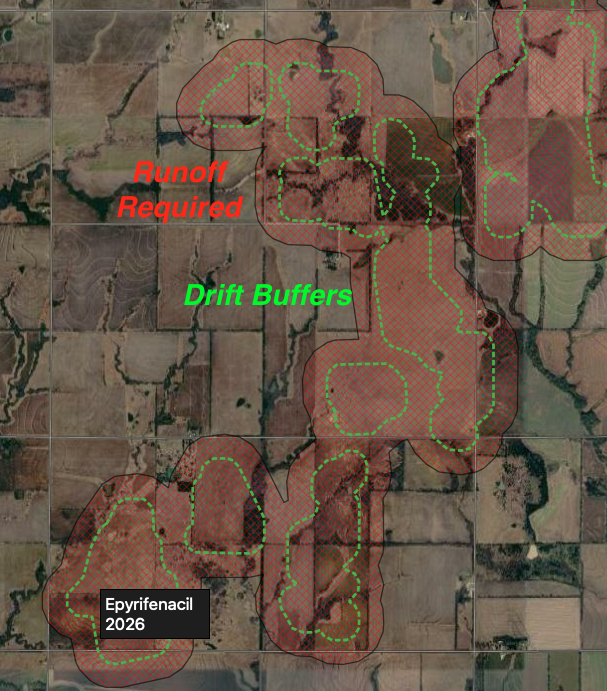
| Drift PULA (buffer codes) | Sits inside runoff PULA (EP125) | Overlap |
|---|---|---|
| 124 | 134 (VSAP 2026) | ~1.6M acres, 100% contained |
| 127 | 133 | ~145,000 acres, 100% contained |
| 130 | 131 | ~97,000 acres, 100% contained |
| 125 | 132 | ~68,000 acres, 100% contained |
Roughly 1.9 million acres where a drift buffer applies are also acres where three points of runoff/erosion mitigation are required. If a bulletin gives you a 170-ft aerial buffer on those acres, assume the 3-point runoff obligation comes with it, and that obligation has to be satisfied by practices already in place before the sprayer moves.
Only PULAs 126 and 129 carry drift codes without a corresponding runoff area.
Where These Acres Actually Are
Intersecting the ten epyrifenacil PULA geometries against county boundaries puts the combined footprint at about 2.69 million acres across 13 states, and it is nowhere near evenly spread:
| State | Drift buffer | Runoff points | Combined |
|---|---|---|---|
| Mississippi | 976,847 | 1,382,755 | 1,382,759 |
| Tennessee | 618,404 | 794,115 | 794,112 |
| California | 144,565 | 204,167 | 204,168 |
| Kansas | 61,811 | 103,619 | 103,619 |
| Georgia | 60,555 | 86,288 | 86,288 |
| Alabama | 60,267 | 80,805 | 80,805 |
| Washington | 11,953 | 0 | 11,953 |
| Minnesota | 10,743 | 0 | 10,743 |
| Virginia | 4,618 | 7,128 | 7,128 |
| Missouri | 3,380 | 6,154 | 6,154 |
| Illinois | 2,979 | 4,963 | 4,963 |
| New York | 1,936 | 0 | 1,936 |
| South Dakota | 47 | 0 | 47 |
| Total | 1,958,105 | 2,669,994 | 2,694,674 |
The first two columns don't add up to the third: drift acres sit inside runoff acres wherever both apply, so the combined column counts that ground once.
Mississippi and Tennessee carry 81% of the total. That's Mid-South Delta country: If you operate in the Delta, treat these PULAs as a planning item for next season rather than an edge case.
Splitting the footprint three ways sharpens the point:
- ~1.93 million acres (72%) carry both a drift buffer and the 3-point runoff requirement.
- ~737,000 acres (27%) carry runoff only: the outer margins of the EP125 areas, beyond the drift polygons nested inside them.
- ~25,000 acres (under 1%) carry drift only, and all of it is in Washington, Minnesota, New York and South Dakota, the four states with no epyrifenacil runoff area at all.
South Dakota's 47 acres is a boundary sliver.
The Bulletins Are Stricter Than the Labels
Both epyrifenacil labels set drift buffers on a sliding scale by application rate. Here's the table straight off the Empera label. Note that the buffer moves with the rate, from 50 ft up to 140 ft for aerial:
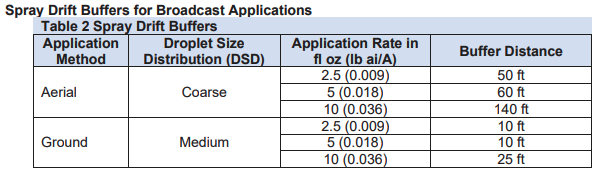
The bulletins largely discard that scale in favor of a flat, higher number:
| Label buffer (by rate) | Bulletin buffer | Difference | |
|---|---|---|---|
| Empera® aerial | 50 / 60 / 140 ft | 170 ft flat | +30 to +110 ft |
| Empera® ground | 10 / 10 / 25 ft | 25 ft flat | +15 ft at low rates |
| Empera Viragess™ aerial | 60 / 80 / 140 ft | 170 ft flat | +30 to +110 ft |
| Empera Viragess™ ground | 10 / 15 / 25 ft | 25 ft flat | +10 to +15 ft |
The practical consequence: inside a PULA, cutting your rate no longer cuts your buffer. Off-PULA acres get the label's rate-sensitive treatment: 2.5 fl oz of Empera® aerial means 50 ft. The same application inside an EP225 area means 170 ft. The one exception is the very lowest Empera® rate, where the bulletin is silent and the label's 50 ft carries.
What Counts Toward the Buffer
The buffer is measured from the downwind edge of the treated area, but it does not have to be bare ground you own and give up. Downwind managed areas that are immediately adjacent and contiguous to the field count toward the required footage:
- Agricultural fields, pastures, forage fields and private rangeland, including untreated portions of the treated field itself
- Roads, paved or gravel surfaces, mowed grassy or fallowed strips, and freshly plowed or graded bare ground
- Buildings and their perimeters, silos, and other roofed or walled structures
- Runoff/erosion practices: vegetative filter strips, field borders, grassed waterways, vegetated ditches, riparian areas
- Drift-reduction plantings: windbreaks, hedgerows, shelterbelts, woodlots, private forest
- CRP and ACEP acres
- On-farm contained irrigation water: canals, ditches, retention basins, farm ponds
On a field bordered by a county road and a neighbor's corn, a 25-ft ground buffer may already be satisfied without leaving a single unsprayed row.
One Product Can Mitigate the Buffer. The Other Can't.
This is the detail most likely to trip people up, because the two epyrifenacil products do not behave the same way.
Empera® carries an explicit Reduction Options for Ecological Wind-Directional Spray Drift Buffers section. Applicators may use EPA Mitigation Menu options (coarser droplets, lower boom, fewer passes, a windbreak, reduced rate) and stack them up to a 100% reduction, meaning no buffer at all.
Empera Viragess™ has no such section. Its label references the Mitigation Menu in exactly one context: defining which managed areas may count toward the buffer footage. There is no grant of buffer reduction anywhere on the label. Those distances are fixed. The only relief is the managed-area footage described above.
The rule of thumb: a bulletin can't authorize a reduction the label doesn't grant. Look for a "Reduction Options" heading on the label before assuming Mitigation Menu credits will shrink your buffer.
It's still not entirely clear that if the label allows for drift mitigation via the Mitigation Menu, does that privilege extend to the PULA even if the limitation text doesn't reference the Mitigation Menu? It's not unreasonable to assume it does, but it needs clarification from the EPA
The Runoff Side: A Drafting Choice Worth Watching
Epyrifenacil isn't the only chemistry that moved this month. Three trifludimoxazin products from BASF joined the VSAP 2025 PULA, and all three carry a runoff requirement on the label itself, independent of any bulletin.



All three use the same sentence. Only the crop list changes:
"The minimum of 6 mitigation points must be achieved for the following agricultural crop use sites: bearing and nonbearing fruit and nut trees, corn, postharvest/fallow, legumes vegetables, peanut, small grains, sorghum, and soybean." Tirexor Herbicide (EPA Reg. No. 7969-492)
Rexovor's list drops the trees. Voraxor's drops the trees and peanut:
| Crop use site | Tirexor | Rexovor | Voraxor |
|---|---|---|---|
| Corn, fallow/postharvest, legume vegetables, small grains, sorghum, soybean | 6 points | 6 points | 6 points |
| Peanut | 6 points | 6 points | not a labeled use |
| Bearing / nonbearing fruit and nut trees | 6 points | not a labeled use | not a labeled use |
Nothing is actually exempt. Each list matches that product's own registered uses exactly. Voraxor doesn't drop peanut from a runoff requirement; peanut was never a Voraxor use. On the Rexovor and Voraxor labels, nut trees and peanut appear only in the rotational crop tables, as plant-back intervals. All three require 6 points on every agricultural crop they're registered for. When comparing products, an absent crop can mean the mitigation doesn't apply or that the product isn't cleared for that crop at all, and only the use list tells you which.
But enumerating invites the opposite reading. Compare how the same registrant wrote it on Liberty® ULTRA, the first herbicide label to carry EPA's runoff points:
"You must achieve a minimum of three points for the crop uses listed on this label unless otherwise stipulated below." Liberty® ULTRA Herbicide (EPA Reg. No. 7969-500)
That points at the label's own use list instead of restating it, and "unless otherwise stipulated below" leaves room for a real carve-out without implying one exists. Both labels are correct. Only one is unambiguous.
The precedent is the concern. Labels have always set the floor: a minimum point total for every application, which Bulletins Live! Two then raises where runoff concern is higher. Some bulletins are additive, like the "3 ADDITIONAL points (for a total of 6 points)" language carried by Engenia, Tavium and Stryax. Others state the raised figure outright, like epyrifenacil's "3 TOTAL points." What's new here is the label enumerating which crops the floor covers. That adds a crop axis to a system that has so far varied by product and geography, and it's the axis most likely to be misread, because a list of crops reads as a scope limitation whether or not it was meant as one.
The ask for registrants is small: write "the crop uses listed on this label," and stipulate genuine exceptions explicitly. Enumerating the full use list under phrasing that reads like an exception creates ambiguity at no benefit to anyone.
Label or Bulletin? The Labels Answer Directly
All three trifludimoxazin labels open the runoff section with the same routing instruction:
"Applicators must access and search Bulletins Live! Two (BLT) ... within six months prior to or on the day of the application to determine whether the application site falls within a Pesticide Use Limitation Area (PULA). If you are located inside a PULA, follow the instructions in the BLT bulletin. If the application site falls outside of a PULA, follow the instructions in the section below."
So the 6-point requirement is explicitly the outside-a-PULA branch. Inside VSAP 2025, the bulletin instruction for all three products is not a points total at all:
"Do not apply within the use limitation area between September 15 and May 15." Limitation code E223
A seasonal prohibition, not a mitigation target. Where a bulletin and label appear to point different directions, the labels also instruct that "additional restrictions may be present in bulletins; always follow the most restrictive bulletin instructions," so confirm the live bulletin before assuming either obligation drops away.
See a Tirexor field assessment in our ESA Portal
A live example showing how Tirexor's label runoff points and the bulletin's seasonal restriction come together on a real field.
The Full Picture Across This Month's Products
Stacking every new product against what its label asks for versus what the bulletins add:
| Product | Active ingredient | Label runoff requirement | What the PULA adds |
|---|---|---|---|
| Empera® | Epyrifenacil | None | 3 points, drift buffers, or a seasonal ban depending on code |
| Empera Viragess™ | Epyrifenacil premix | None | Same |
| Tirexor | Trifludimoxazin | 6 points, all labeled crops | Seasonal ban (E223) |
| Rexovor | Trifludimoxazin | 6 points, all labeled crops | Seasonal ban (E223) |
| Voraxor | Trifludimoxazin + saflufenacil | 6 points, all labeled crops | Seasonal ban (E223) |
| Diflufenican SC500 | Diflufenican | 2 points | Seasonal ban (E223) |
| Emiox | Florylpicoxamid | None | Seasonal ban, Mar 1 – Jun 30 (FP125) |
Two opposite patterns sit in the same month's data. Epyrifenacil carries no runoff obligation on its label: the PULA invents one. Trifludimoxazin carries a heavier one (6 points) on its label than any bulletin imposes: the PULA swaps it for a calendar restriction. Knowing a product is "in a PULA" tells you almost nothing about which of those you're facing.
New Prairie Dog Rodenticide: NERC24-2
The six existing Kaput/Rozol black-tailed prairie dog PULA groups were all updated to add NERC24-2 (EPA Reg. No. 61282-107), a diphacinone loose-bait product, under a new set of "GRK" limitation codes.
The NERC24-2 restrictions mirror the limitations already in place for Kaput-D, Kaput COMBO, and Rozol Prairie Dog Bait in each area:
| Code | Restriction |
|---|---|
| GRK1 | Use is prohibited in the area |
| GRK2 | Use is prohibited within the Indian Reservation |
| GRK3 | Use limited to November 1 – March 15 |
| GRK4 | Use limited to December 1 – March 1 |
| GRK5 / GRK6 | Prairie dog colonies may be occupied by the federally endangered northern aplomado falcon; contact the U.S. Fish and Wildlife Service before application to learn where falcons occur in the county |
If you handle prairie dog control programs, the compliance picture hasn't changed structurally, but a new product is now on the restricted list, and the same pre-application checks apply to it.
Updates to Existing PULAs
Beyond the new areas, two existing PULAs picked up new products and restrictions:
Florylpicoxamid on Golf Courses
Emiox (EPA Reg. No. 62719-790, florylpicoxamid) was added to a Florylpicoxamid 2025 PULA under code FP125:
"Do not apply florylpicoxamid within this area from March 1 to June 30."
This applies to golf course use. Note the Emiox label prohibits aerial application outright ("DO NOT apply aerially").
VSAP 2025 PULA Expands Significantly
A 2025 Vulnerable Species Action Plan PULA added six products under two codes (E223 and EP325), all carrying identical limitation text:
"Do not apply within the use limitation area between September 15 and May 15."
The six products:
| Product | EPA Reg. No. | Active Ingredient |
|---|---|---|
| Empera® Herbicide | 59639-262 | Epyrifenacil |
| Empera Viragess™ Herbicide | 59639-263 | Epyrifenacil premix |
| Tirexor Herbicide | 7969-492 | Trifludimoxazin |
| Voraxor Herbicide | 7969-495 | Trifludimoxazin |
| Rexovor Herbicide | 7969-494 | Trifludimoxazin |
| Diflufenican SC500 Herbicide | 264-1213 | Diflufenican |
The trifludimoxazin restrictions cover corn and soybean uses (including fallow systems); the diflufenican restriction covers any use of the product in the area.
Worth noting what this PULA does not do: it adds no runoff-point or buffer requirement. For the three trifludimoxazin products, the runoff obligation lives entirely on the label, and as shown above, it's the crop list, not the point total, that varies between them.
What This Means for Your Acres
The pattern from Dicamba, Enlist, and Isocycloseram is now the norm: new chemistry ships with ESA limitations attached. Epyrifenacil never had a pre-PULA era: every acre it's ever applied to will need a BLT check, starting with the first one.
There's also a quieter shift worth tracking. Labels have always set the runoff floor and bulletins have always escalated it locally, but labels are now starting to enumerate which crops that floor covers. It's a small drafting difference today. It's a much larger one if it becomes the norm.
But the harder lesson this month isn't about a single active ingredient. It's that the mitigation obligations attached to a product are no longer a single fact you can look up once. Whether points apply depends on the crop. How many depends on whether you're inside a PULA. Whether a drift buffer can be reduced depends on the specific label, not the active ingredient. Two products with the same AI at the same concentration can differ, and two labels from the same registrant can differ.
Five things to do now:
- Use the lead time. Empera and Empera Viragess don't ship until late 2026, so you have a season to work with. If you operate in Mississippi or Tennessee (four out of five affected acres are in those two states), map which fields fall in epyrifenacil PULAs now. Where EP125 applies, runoff mitigation practices have to be established before application, and this fall is the window.
- Assume drift and runoff travel together, except in four states. On the ~1.93 million acres where drift areas sit inside runoff areas, a buffer requirement is a signal to check the runoff obligation too. Washington, Minnesota, New York and South Dakota are the exception: drift buffers apply there, runoff points don't.
- Check whether the buffer is reducible before you plan around it. Empera®'s is; Empera Viragess™'s is not. Then check what's already downwind; managed-area footage may cover more of the requirement than you'd expect.
- Record runoff points against the product and the crop. EPA writes the requirement per crop use site, so that's how it should be stored. And when a crop is missing from one product's list but not another's, check the label's registered uses before drawing a conclusion: it usually means the product isn't cleared for that crop at all, not that the mitigation was waived.
- Watch the seasonal windows and re-check assessed fields. EP325- and E223-coded areas rule out fall burndown and most early pre-plant timing entirely, and several existing PULAs gained new products this month, so a field that was clear in June may carry a new restriction today.
AcreBlitz tracks every BLT data refresh so you don't have to diff it by hand. Our PULA Check API and ESA Field Exchange platform give trusted advisors instant, field-level answers on which limitations apply to which acres, including the new epyrifenacil areas. See it for yourself with our live portal examples for Empera® and Tirexor.
Learn More at AcreBlitz.com →Source: EPA Bulletins Live! Two data, July 2026 refresh. Analysis based on a comparison of AcreBlitz BLT data snapshots from early and mid-July 2026; buffer and mitigation details drawn from the current Empera®, Empera Viragess™ 0.94 SE, and Vertento product labels, and PULA overlap and per-state acreage figures computed from the published BLT geometries intersected against U.S. county boundaries. Product availability timing and brand names per Valent U.S.A.'s registration announcement of July 2, 2026. Always confirm current limitations in Bulletins Live! Two within 6 months prior to or on the day of application, and follow the product label for the product you are applying.